Table of Contents
B2B PPC tips are essential for businesses aiming to unlock new growth avenues in today’s digital environment. By implementing B2B Pay-Per-Click (PPC) strategies, companies can efficiently connect with their target business audiences and transform prospects into valuable leads.
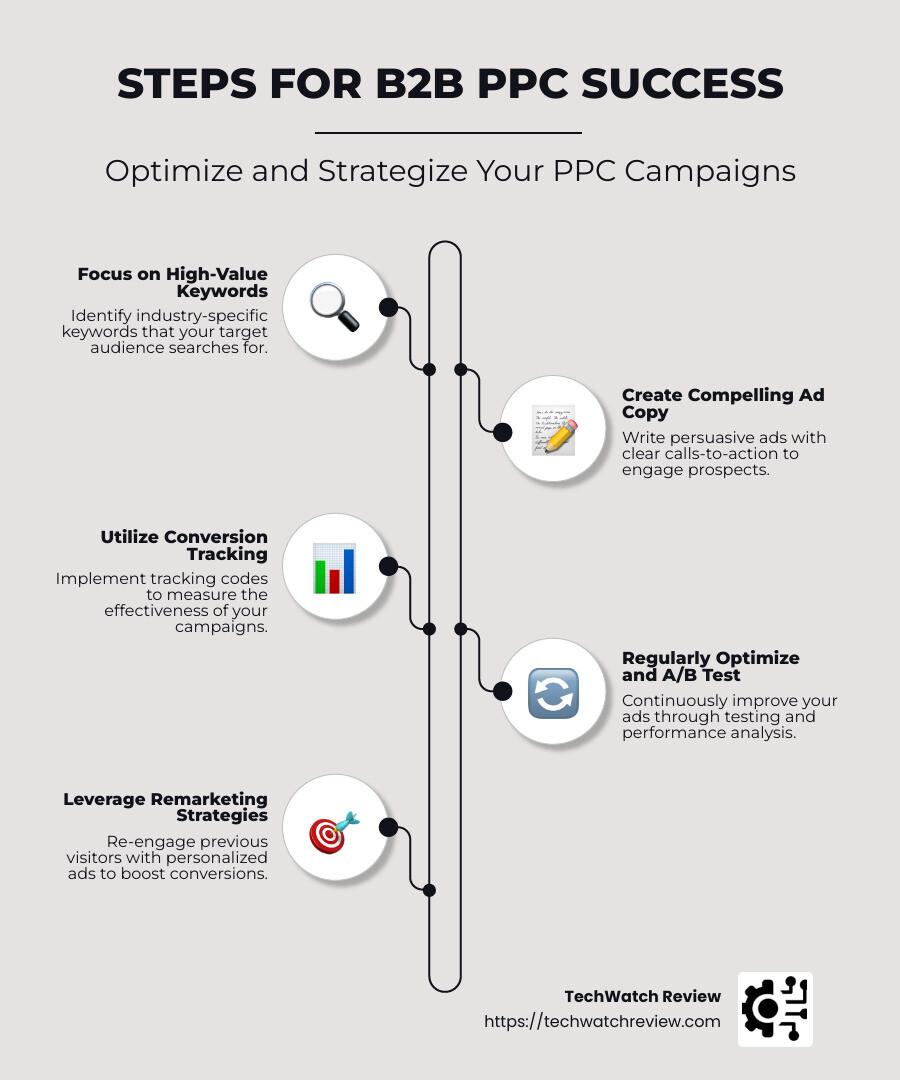
Quick Tips for B2B PPC Success:
– Focus on high-value keywords specific to your industry.
– Create compelling ad copy with clear calls-to-action.
– Use conversion tracking to measure success.
– Regularly optimize and A/B test your campaigns.
In the competitive realm of B2B marketing, differentiation is key. Unlike B2C marketing, which targets individual consumers, B2B PPC is about engaging with other businesses. This strategy enables companies to reach decision-makers actively seeking solutions that fulfill their business requirements.
TechWatch Review understands these challenges and is dedicated to guiding tech-savvy professionals through the intricate landscape of digital marketing. Our expertise in B2B PPC offers concise and reliable insights, assisting you in making informed decisions and maintaining a competitive edge in the rapidly changing tech landscape.

Explore related topics to b2b ppc tips:
– b2b digital marketing tips
– b2b seo tips
– b2b lead generation tips
What is B2B PPC?
B2B PPC, or Business-to-Business Pay-Per-Click advertising, is a powerful tool for companies looking to connect with other businesses. Unlike B2C (Business-to-Consumer) PPC, which targets individual consumers, B2B PPC focuses on reaching businesses that need specific products or services. This difference is crucial because the buying process in B2B is typically more complex, involving multiple decision-makers and longer sales cycles.
B2B vs. B2C PPC
In B2B PPC, the target audience is not a single consumer but entire companies or departments. This means your ads need to speak to the needs and pain points of businesses, not individuals. While B2C PPC might focus on emotional appeals to drive quick sales, B2B PPC requires a more logical approach, highlighting the benefits and ROI of your products or services.
Target Audience and Buying Process
Targeting the right audience is essential in B2B PPC. You need to consider factors like industry, job titles, and company size. Understanding your audience’s buying process is key. In B2B, the process often involves research, evaluation, and approval by multiple stakeholders. This is why your ads should be informative and aimed at different stages of the buying journey.
Ad Targeting and Conversion Goals
B2B PPC allows for precise ad targeting using platforms like Google Ads and LinkedIn Ads. You can target based on specific criteria such as industry, company size, and even job titles. This precision helps ensure that your ads reach the right people at the right time.
Setting clear conversion goals is vital. Whether it’s lead generation, increasing brand awareness, or driving website traffic, your goals will guide your campaign strategy. Using tools like Google Analytics can help track these goals and measure success.
Ad Formats and Platforms
There are various ad formats you can use in B2B PPC, from text and display ads to video and sponsored content. Each format has its strengths, so choose the one that best aligns with your campaign objectives.
- Google Ads: Ideal for targeting professionals actively searching for solutions.
- LinkedIn Ads: Perfect for reaching business decision-makers based on job titles and industries.
- Facebook Ads: Useful for targeting custom audiences, including interests and company affiliations.
These platforms offer unique features that can improve your B2B PPC campaigns. For example, LinkedIn’s professional targeting options allow you to reach decision-makers directly, making it a popular choice for B2B marketers.
By understanding the nuances of B2B PPC and leveraging the right strategies, businesses can effectively reach their target audiences and achieve their marketing goals.
For more insights on optimizing your PPC strategies, you can explore Gartner’s PPC Optimization Strategies. Additionally, check out our article on Effective B2B Marketing Techniques for further guidance.
Benefits of B2B PPC
When it comes to marketing strategies, B2B PPC stands out for its ability to deliver measurable results quickly. Here’s how it can transform your business:
Increased Visibility
B2B PPC allows your company to appear at the top of search engine results pages (SERPs) and on relevant websites. This increased visibility improves brand awareness, ensuring that your offerings are seen by a wider audience. According to recent statistics, PPC search ads can boost brand awareness by up to 80% in B2B marketing. For more insights on boosting brand awareness, check out this article.
Precise Targeting
One of the greatest strengths of B2B PPC is its precise targeting capabilities. You can tailor your campaigns to reach specific industries, job titles, and company sizes. This ensures that your ads are seen by the most relevant audience, maximizing the effectiveness of your marketing efforts. For example, platforms like LinkedIn Ads are ideal for targeting business decision-makers based on professional criteria. Learn more about targeting strategies here.
Cost-Effective
Unlike traditional advertising methods, PPC is cost-effective because you only pay when someone clicks on your ad. This pay-per-click model allows you to manage your budget effectively and ensures a good return on investment (ROI). Plus, detailed analytics tools help track every dollar spent, allowing for data-driven optimizations. Discover more about managing PPC budgets here.
Quick Results
PPC campaigns can be launched quickly, delivering immediate results. This is particularly beneficial for businesses looking to generate leads and drive conversions in a shorter timeframe. Compared to other marketing strategies, PPC offers a faster way to connect with potential clients who are actively searching for your products or services.
Improved Lead Generation
By targeting keywords and phrases relevant to your B2B offerings, PPC attracts qualified leads. This focused approach increases the chances of acquiring new customers. For instance, York Saw and Knife, an industrial blade manufacturer, increased their Google Ads conversions by 108% through a strategic B2B PPC campaign. For more on improving lead generation, visit this page.
Remarketing Opportunities
PPC platforms offer remarketing capabilities, allowing you to re-engage website visitors who have shown interest in your products. By displaying targeted ads to these prospects, you can nurture them through the B2B buyer’s journey, increasing the likelihood of conversion. Explore remarketing strategies here.
Flexibility and Scalability
B2B PPC campaigns offer flexibility to adjust budgets, targeting options, and ad creatives based on performance and business needs. This scalability allows you to allocate resources effectively and optimize your campaigns for maximum ROI.
Competitive Advantage
Leveraging PPC advertising gives B2B companies a competitive edge. By strategically bidding on keywords and crafting compelling ad copy, you can outperform competitors and capture the attention of potential customers. 
Integration with Other Channels
B2B PPC can be seamlessly integrated with other marketing channels, such as social media and email marketing. This creates a cohesive strategy that reaches your target audience across multiple touchpoints, enhancing overall campaign effectiveness.
By understanding and utilizing these benefits, businesses can harness the power of B2B PPC to achieve their marketing goals and drive growth. Next, we will dig into how to build a successful B2B PPC campaign, focusing on setting goals, identifying target audiences, and more.
How to Build a Successful B2B PPC Campaign
Creating a successful B2B PPC campaign involves several key steps, each designed to maximize your return on investment and drive quality leads. Let’s explore the process.
Define Your Campaign Goals
Start by setting clear, specific goals for your campaign. Are you looking to generate leads, increase brand awareness, drive website traffic, or boost sales? Defining these goals will help you align your PPC strategy with your business objectives. For example, if lead generation is your goal, focus on capturing contact information through targeted landing pages.
Identify Your Target Audience
Understanding your audience is crucial. Consider demographics, interests, pain points, and buying behavior. Creating detailed buyer personas will guide your ad targeting and messaging. Tools like LinkedIn can provide insights into your audience’s professional demographics, helping you tailor your ads to the right people.
Conduct Keyword Research
Effective keyword research is the backbone of any successful PPC campaign. Use tools like Google Keyword Planner or Semrush to find relevant keywords. Focus on long-tail keywords, which often have lower competition and higher conversion rates. Don’t forget to incorporate negative keywords to filter out irrelevant traffic.
Create Compelling Ad Copy
Your ad copy should be persuasive and highlight your unique value proposition. Use clear language and a strong call-to-action (CTA) that tells users exactly what to do next. For instance, if you’re offering a free trial, make sure your CTA reflects that, such as “Start Your Free Trial Today.”
Design Landing Pages
Design landing pages that align with your ad copy and are optimized for conversions. Ensure they provide valuable information and have a clear path to action. A well-designed landing page can significantly increase your conversion rates. Tools like Unbounce can help create effective landing pages custom to your campaign.
Set Up Conversion Tracking
Implement conversion tracking to measure the success of your campaign. This involves placing tracking codes on your website to monitor key metrics, such as leads generated or sales completed. Linking your Google Ads account with Google Analytics or HubSpot can provide deeper insights into your campaign performance.
Optimize Your Campaign
Continuous optimization is key to improving your PPC campaign. Conduct A/B testing on your ad copy, landing page design, and targeting options to see what resonates best with your audience. Regularly review performance data to make informed adjustments.
Use Remarketing Strategies
Remarketing allows you to re-engage users who have previously interacted with your site. By showing them personalized ads based on their past behavior, you can increase the chances of conversion. This strategy is particularly effective for nurturing leads through the B2B buyer’s journey.
Monitor and Analyze Data
Regularly review your campaign data using analytics tools. This helps you make data-driven decisions and optimize your strategy. Look at metrics like click-through rates, conversion rates, and cost-per-click to assess your campaign’s effectiveness. Adjust your approach based on these insights to maximize your results.
By following these steps, you can build a B2B PPC campaign that effectively targets your audience and achieves your marketing objectives. Next, we’ll explore top strategies to attract the right leads to your PPC ads, focusing on pre-qualifying your leads and crafting targeted ad copy.
Top Strategies to Attract the Right Leads to Your PPC Ads
When it comes to B2B PPC, attracting the right leads is crucial. Let’s explore some effective strategies to ensure your ads reach the right audience.
Pre-Qualify Your Leads
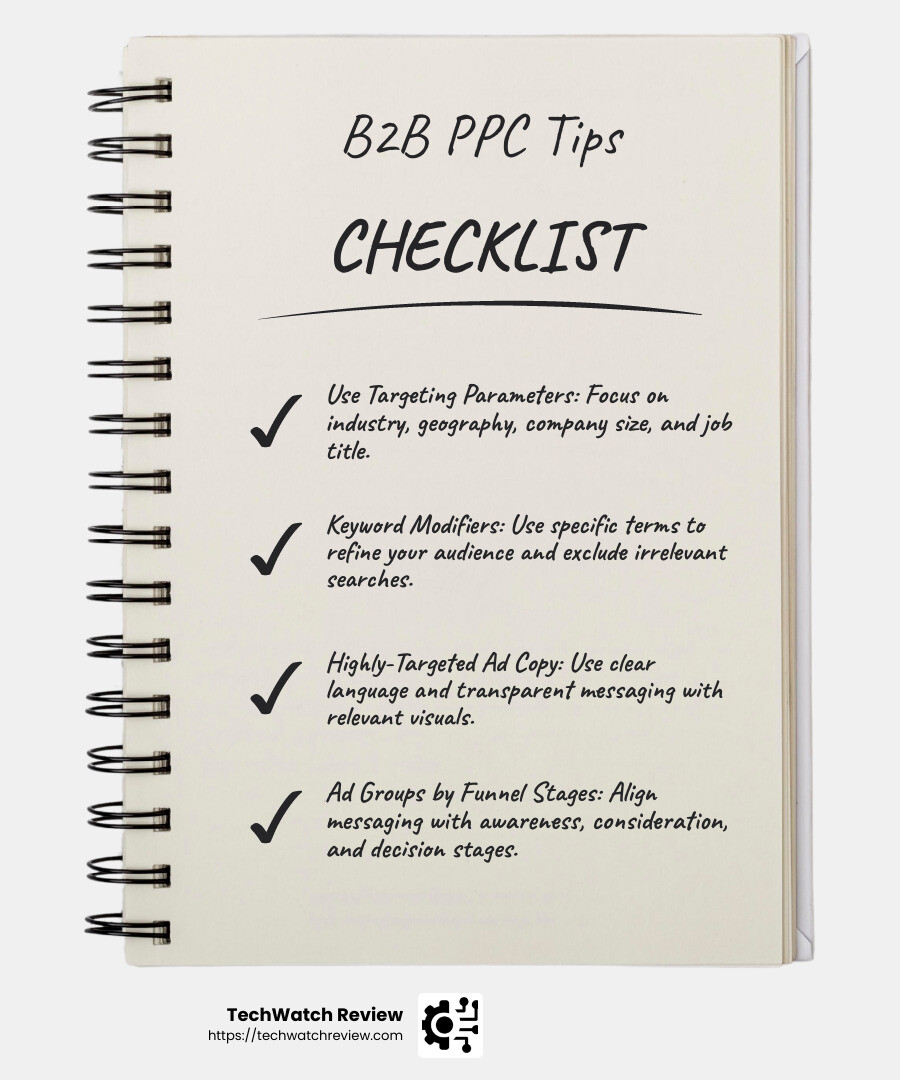
Pre-qualifying your leads is essential to avoid wasting your budget on uninterested clicks. Targeting parameters such as industry, geography, company size, and job title can help you narrow down your audience. For instance, if you’re targeting large tech companies in California, set your ads to appear only to users in that location with relevant job titles.
Keyword modifiers are another tool to refine your audience. Use specific terms like “enterprise software solutions” instead of just “software solutions” to reach decision-makers in large companies. Don’t forget to include negative keywords to exclude irrelevant searches. For example, if your product isn’t free, add “free” as a negative keyword to filter out users looking for free options.
Use Targeting Parameters and Keyword Modifiers
Effective use of targeting parameters can significantly improve your campaign’s performance. By focusing on specific industries or job roles, you ensure your ads are seen by those most likely to convert. For example, targeting “IT managers in healthcare” can be more effective than a broad “IT professionals” target.
Keyword modifiers further refine this approach. They help you bid on phrases that align closely with your offering. For instance, if you sell bulk office supplies, keywords like “bulk office supplies” or “wholesale office supplies” are more precise than “office supplies.”
Create Highly-Targeted Ad Copy
Crafting ad copy that speaks directly to your target audience is vital. Use clear and concise language that highlights your unique value proposition. Make sure your headline grabs attention and is relevant to the search query.
Transparency in your ad copy is key. Clearly state what you offer to ensure only interested users click on your ad. For example, if you provide “B2B SaaS solutions,” make that clear upfront to avoid clicks from B2C users.
Visuals also play a role in attracting the right leads. Ensure your images or graphics align with your brand and message.
Build Ad Groups Based on Sales Funnel Stages
Organizing your ad groups according to the sales funnel stages—awareness, consideration, and decision—can improve your targeting precision. Each stage has different needs:
- Awareness Stage: Use broad keywords and informative content to educate potential leads about your brand.
- Consideration Stage: Target users who are comparing options with more specific keywords and detailed information about your offerings.
- Decision Stage: Focus on conversion-driven keywords and strong CTAs to encourage final action.
By structuring your ad groups this way, you can tailor your messaging to meet leads where they are in their journey, increasing the likelihood of conversion.
For more insights on optimizing your PPC strategy, check out our guide on PPC best practices.
These b2b ppc tips help ensure your ads reach the right audience, maximizing your return on investment. Next, we’ll discuss the best PPC platforms for B2B marketing, exploring options like Google Ads and LinkedIn Ads for professional targeting.
Best PPC Platforms for B2B Marketing
When it comes to B2B marketing, choosing the right PPC platform can make all the difference in reaching your target audience effectively. Let’s look at the top platforms that can help you achieve your goals.
Google Ads
Google Ads is the most popular PPC platform, offering an extensive reach and a variety of ad formats. Its powerful targeting options allow you to focus on specific keywords and demographics, ensuring your ads appear to potential customers actively searching for your products or services. With robust analytics and conversion tracking, you can optimize your campaigns for maximum ROI.
Google’s wide reach makes it a go-to choice for businesses looking to increase visibility and drive targeted traffic. Its tools like the Google Keyword Planner help you identify valuable keywords to improve your campaign’s effectiveness. For more insights on using Google Ads effectively, check out this article on TechWatch Review.
LinkedIn Ads
For B2B marketers, LinkedIn Ads is a must-consider platform. LinkedIn allows you to target professionals based on job titles, industries, company size, and more. This precise targeting makes it ideal for reaching decision-makers and generating high-quality leads.
Unique ad formats such as Sponsored Content and Sponsored InMail let you engage with your audience in a professional setting, enhancing the credibility of your brand. A case study by Appsee showed a 3.4X increase in click-through rates with LinkedIn Ads, demonstrating its effectiveness in B2B marketing. Learn more about leveraging LinkedIn Ads in this guide.
Facebook Ads (Meta Ads)
While traditionally seen as a B2C platform, Facebook Ads can be highly effective for B2B campaigns. With detailed targeting options, you can create custom audiences based on interests, job titles, and company affiliations.
Facebook’s high engagement rates and cost-effective campaigns make it a valuable tool for reaching a broad audience. By utilizing visual storytelling through platforms like Instagram, you can create memorable content that resonates with your target market. For strategies on using Facebook Ads for B2B, visit this resource.
Twitter Ads
Twitter Ads offers a unique opportunity for real-time engagement. Through promoted tweets, accounts, and trends, you can reach professionals interested in industry news and discussions.
This platform is excellent for building brand awareness and driving website traffic. By targeting specific industries or job roles, you can ensure your ads are seen by the right people, enhancing your campaign’s effectiveness. For more on Twitter Ads, explore Twitter’s business page.
Microsoft Advertising
Microsoft Advertising, formerly Bing Ads, provides access to a unique audience, particularly among older professionals and enterprise customers. Its integration with LinkedIn allows for advanced targeting based on LinkedIn profiles, making it a valuable platform for B2B marketing.
With lower competition than Google Ads, Microsoft Advertising can offer a cost-effective way to reach potential customers who prefer using Microsoft products. Its integration with AI tools further improves targeting precision, helping you maximize your campaign’s reach. Discover more about Microsoft Advertising here.
These platforms each offer unique benefits and targeting capabilities that can significantly improve your B2B marketing efforts. Next, we’ll address some frequently asked questions about B2B PPC to help you refine your strategy.
Frequently Asked Questions about B2B PPC
Is PPC good for B2B?
Absolutely, PPC is a powerful tool for B2B marketing. Unlike B2C, where purchases are often quick and impulsive, B2B sales cycles are longer and more complex. PPC helps simplify this process by targeting industry-specific keywords that align with the needs of businesses. This targeted approach can initiate valuable relationships with potential clients who are actively seeking your solutions.
A real-world example is York Saw and Knife, which increased their Google Ads conversions by 108% with a strategic B2B PPC campaign. They connected with business buyers searching for industrial blades, demonstrating PPC’s effectiveness in attracting the right audience. For more insights on PPC strategies, you can explore this article on TechWatch Review.
How can I make my PPC more effective?
To improve the effectiveness of your B2B PPC campaigns, focus on effective keywords. Use tools like Google Keyword Planner and SEMrush to identify keywords that are not only relevant but also have high conversion potential. Long-tail keywords, such as “best B2B PPC strategies for lead generation,” can be particularly effective because they often match closely with user intent.
Adopt a value-first approach in your ad copy by clearly stating your unique value proposition and including a strong call to action. This encourages potential leads to take the next step. Additionally, use targeting parameters to reach specific industries, job titles, or company sizes. This ensures your ads are seen by decision-makers who are more likely to convert. For more tips on crafting compelling ad copy, check out this guide on TechWatch Review.
How to run B2B ads?
Running successful B2B ads begins with knowing your audience. Create detailed buyer personas to understand their pain points and buying behavior. This knowledge helps you tailor your ads to address their specific needs.
Next, define success by setting clear, measurable goals for your campaign. Whether it’s lead generation, increased website traffic, or brand awareness, having defined objectives will guide your strategy and help measure outcomes.
Finally, regularly monitor and analyze your campaign’s performance using analytics tools like Google Analytics or HubSpot. By reviewing data such as click-through rates, conversion rates, and ROI, you can make informed decisions to optimize your ads for better results. PPC is not a one-time effort. Continuous testing and optimization are key to maintaining a successful B2B PPC strategy. For more on analytics, visit this article on TechWatch Review.
In the evolving realm of B2B marketing, PPC remains a pivotal strategy for achieving success. By utilizing targeted advertising, businesses can precisely reach their ideal audience, ensuring their message resonates with potential clients.
A crucial takeaway is the significance of continuous optimization. As emphasized by experts like Dang, regularly analyzing your campaign’s performance and adjusting your approach based on data insights is essential. This involves refining your keywords, ad copy, and bidding strategies to maximize ROI and effectively engage your target market.
Staying updated with industry trends is also vital. The digital marketing world is dynamic, with new tools and techniques emerging regularly. By keeping abreast of these developments, you can ensure your PPC campaigns are cutting-edge and effective. Platforms like TechWatch Review’s marketing section provide valuable insights and updates to help you stay informed and ahead of the competition.
In summary, a successful B2B PPC campaign is not a set-it-and-forget-it endeavor. It requires ongoing attention, adaptation, and a willingness to evolve with the market. By following these strategies and continuously refining your approach, you can harness the full potential of PPC to achieve your business goals.


