Exploring Telecom Systems: Key Components and Functions
Table of Contents
The Backbone of Communication
Telecommunications is crucial for the modern world, allowing for the exchange of information across long distances. Whether through wired phones, cellphones, or the Internet, telecommunications systems make this possible.
Key Points:
- Telecommunications enables communication via electronic means over distances.
- Data exchange occurs through various forms like wired and wireless communication.
- Information-transmitting technologies include satellite, fiber optics, and radio.
Telecommunications covers a broad spectrum of technologies, from traditional wired phones to modern fiber optics and satellite communications. The main goal is to transmit voice, data, and video in a seamless and reliable manner.
A complete telecommunications circuit involves two stations, each equipped with a transmitter and receiver, capable of handling vast amounts of data. This technology has evolved to include analog and digital signals, catering to various needs like broadcasting and internet connectivity.
Telecom systems are essential in everyday life, supporting everything from phone calls to internet browsing and TV broadcasting. By understanding the core components and how they function, you will appreciate the complexity and significance of these systems.

For more detailed insights into telecom systems, don’t miss our in-depth guide on telecom management software. Explore the technologies shaping our connected world and see how top companies are driving innovation in this space.
Basic systems telecom vocab:
What is a Telecom System?
A telecom system is a network that enables the exchange of information over long distances using electronic means. This information can be in the form of voice, data, or video transmission.
Telecommunication Definition
Telecommunications refers to the process of transmitting information by various types of technologies over significant distances. It encompasses several modes of communication, including wired phones, cellphones, satellite communications, and the internet.
Electrical Signals and Electromagnetic Waves
At the heart of any telecom system are electrical signals and electromagnetic waves. These are the mediums through which information is transmitted. Electrical signals are used in wired communications, while electromagnetic waves are employed in wireless communications.
Telephone Network
The telephone network is one of the oldest and most fundamental telecom systems. It uses electrical signals transmitted over copper wires or fiber optics to enable voice communication over long distances. Modern telephone networks have evolved to support digital signals, improving the quality and reliability of communication.
Radio Broadcasting System
Radio broadcasting systems use electromagnetic waves to transmit audio content over the air. These systems are vital for disseminating information and entertainment to a wide audience. Radio broadcasts can be either analog or digital, with digital radio offering better sound quality and more efficient use of the spectrum.
Computer Networks
Computer networks are another critical component of telecom systems. They allow computers to exchange data and share resources. These networks can be local (LAN) or wide-area (WAN), and they form the backbone of the internet.
Internet
The internet is the largest and most complex telecom system in existence. It is a global network of interconnected computer networks that use a standard protocol (TCP/IP) to communicate. The internet supports various forms of communication, including email, video conferencing, and web browsing.
Key Takeaways
- Telecom systems enable long-distance communication using electronic means.
- Electrical signals are used in wired communications, whereas electromagnetic waves are used in wireless communications.
- Telephone networks, radio broadcasting systems, and computer networks are fundamental components of telecom systems.
- The internet is the largest and most complex telecom system, supporting a wide range of communication forms.
For more insights on how telecom systems work, check out our article on telecom management software. Learn how these technologies are integrated to provide seamless communication solutions.
Key Components of Telecom Systems
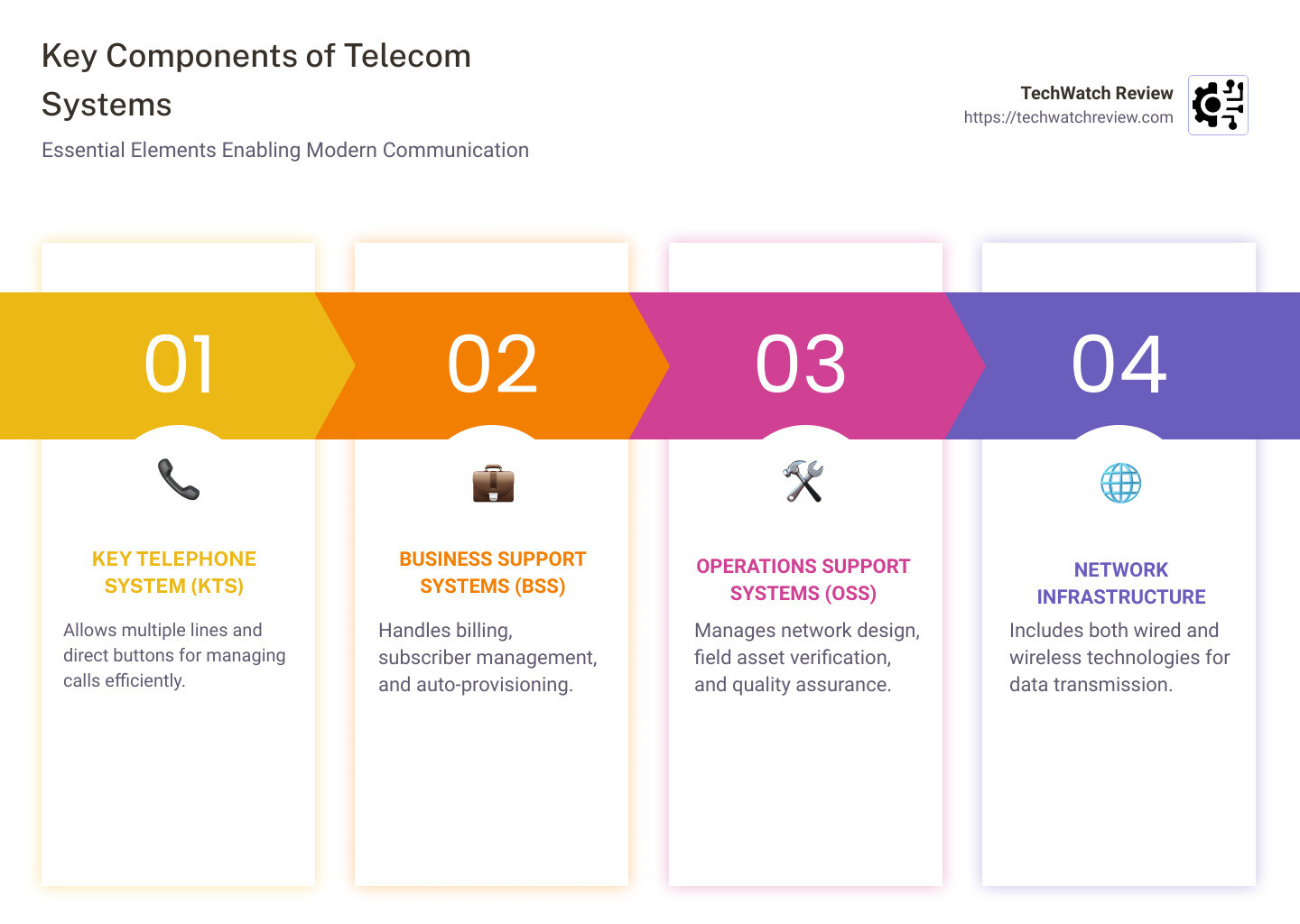
Telecom systems are intricate networks that enable the exchange of information over long distances. Understanding their key components is crucial for grasping how they function. Here, we dig into Key Telephone Systems (KTS), Business Support Systems (BSS), and Operations Support Systems (OSS), which are essential for modern telecommunications.
Key Telephone System (KTS)
A Key Telephone System (KTS) is a multi-line phone system commonly used in small to medium-sized businesses. It allows multiple telephones to share several central office lines. Here are some key features:
- Multiple Keys/Buttons: Each line has a designated button, making it easy to manage multiple calls.
- Line Indicators: Visual indicators show which lines are in use or on hold.
- Attendant Phone: A primary phone that can control the entire system.
- Controller Box: The central unit that connects and manages all the lines and phones.
These systems are ideal for environments where managing multiple calls efficiently is essential. For more on how KTS can streamline your business operations, visit TechWatch Review.
Business Support Systems (BSS)
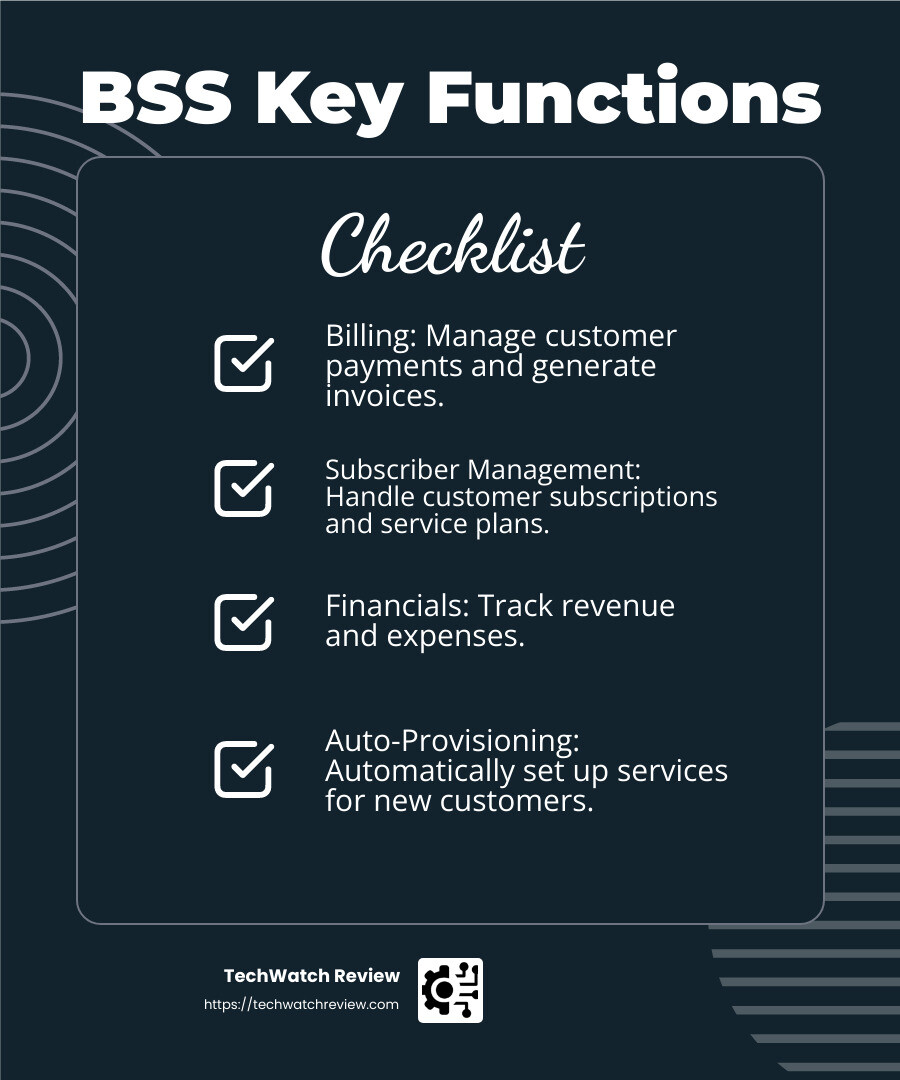
Business Support Systems (BSS) handle the business side of telecom operations. They manage customer-facing activities, making it easier for telecom companies to interact with their customers. Key functions include:
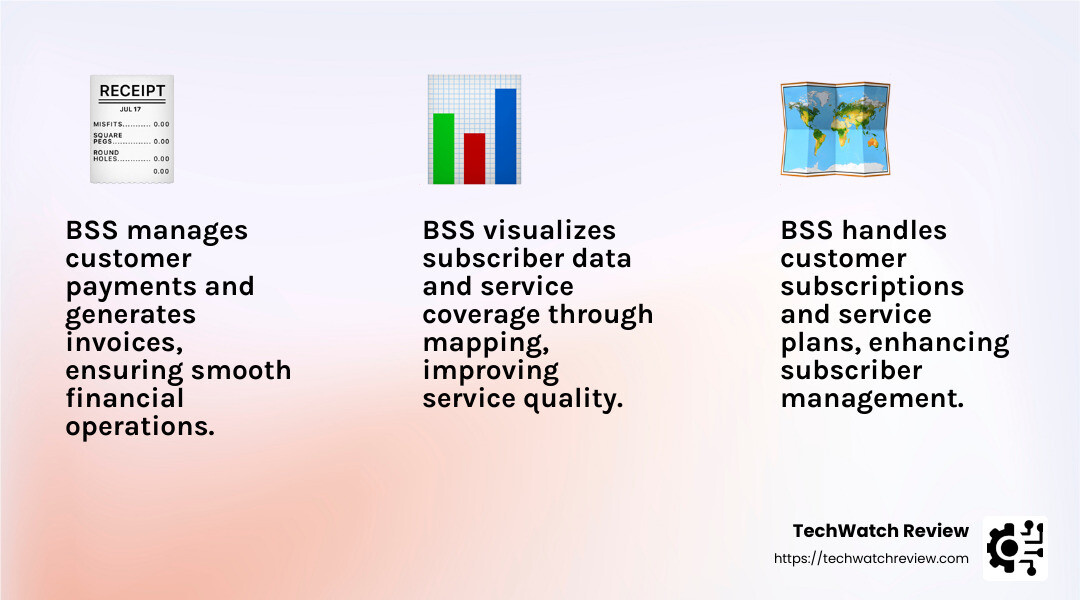
- Billing: Managing customer payments and generating invoices.
- Subscriber Management: Handling customer subscriptions and service plans.
- Financials: Tracking revenue and expenses.
- Auto-Provisioning: Automatically setting up services for new customers.
- Mapping: Visualizing subscriber data and service coverage.
BSS solutions, like the eLation Platform, streamline operations and improve customer satisfaction. According to Innovative Systems, “eLation has allowed us to grow without unnecessarily adding staff,” highlighting its efficiency.
Operations Support Systems (OSS)
Operations Support Systems (OSS) focus on network operations, ensuring everything runs smoothly. They encompass various tasks:
- Network Design: Planning and designing network infrastructure, including fiber, wireless, and HFC (Hybrid Fiber-Coaxial) systems.
- Field Asset Verification: Checking and validating field assets to ensure accuracy.
- Program Management: Overseeing network deployment projects.
- QA/QC: Quality assurance and quality control to maintain high standards.
OSS also includes RF Engineering and GIS (Geographic Information Systems) for network optimization and data analysis.
Network Infrastructure and RF Engineering
Modern telecom systems rely heavily on robust network infrastructure and advanced RF (Radio Frequency) Engineering, complemented by cpaas solutions that enable seamless integration of messaging and voice services. This includes:
- Site Development: Preparing locations for network components.
- Field Assessments: Evaluating field conditions and assets.
- Deployment Project Management: Coordinating the installation and setup of network systems.
These elements are crucial for maintaining a reliable and efficient telecom network. For instance, Telcom offers comprehensive services from network design to field deployment, ensuring seamless operations.
Geographic Information Systems (GIS)
GIS plays a vital role in telecom systems by providing critical insights through data visualization and analysis. Key functions include:
- Geospatial Mapping and Analysis: Visualizing network coverage and infrastructure.
- Data Validation: Ensuring the accuracy of spatial data.
- Design and Modeling: Using digital twins for network planning.
GIS helps telecom companies make informed decisions, driving value and efficiency. As an Esri partner, Telcom leverages dual certifications in Esri Enterprise System Design and Administration to deliver top-notch GIS solutions.
Cloud Migration and Data Analytics
Cloud Migration and Data Analytics are changing telecom systems. Moving to the cloud reduces costs and increases efficiency, while data analytics provides actionable insights. Key benefits include:
- Cost Reduction: Lower operational expenses by rightsizing cloud resources.
- Increased Efficiency: Streamlined processes from production to servicing.
- Actionable Insights: Leveraging data for better decision-making.
For example, Telcom’s cloud-centric supply chain combines world-class cloud providers with a persistent data layer, optimizing the entire process.
Summary
Understanding the key components of telecom systems—KTS, BSS, and OSS—is essential for grasping how these networks function. From managing multiple phone lines to handling customer interactions and ensuring network reliability, these systems are the backbone of modern telecommunications. For more detailed insights, explore our in-depth articles.
Next, we will explore the different types of telecommunications systems, focusing on analog and digital technologies.
Types of Telecommunications Systems
Telecommunications systems can be broadly categorized into two main types: Analog Telecommunications Systems and Digital Telecommunications Systems. Here’s a closer look at each:
Analog Telecommunications Systems
Analog Telecommunications Systems were the first to be developed and are still in use today for specific applications. These systems rely on analog signals, which are continuous waves that vary in amplitude or frequency to represent information.
Voice Communication: Analog systems are often used for voice communication. The human voice is converted into electrical signals that travel over a communication channel, such as a telephone line. These signals are then converted back into sound at the receiving end.
Electromagnetic Signals: Analog signals are a type of electromagnetic signal. They can be transmitted over various media, including electrical wires, coaxial cables, and radio waves.
Communication Channel: The channel in analog systems can be anything that can carry the electromagnetic signal, such as copper wires for landline phones or radio frequencies for AM and FM radio.
Digital Telecommunications Systems
Digital Telecommunications Systems are more advanced and widely used today. These systems use digital signals, which are discrete and represent data using binary code (1s and 0s). This makes digital systems more efficient and less susceptible to noise and interference than analog systems.
Data Communication: Digital systems excel in data communication. They convert data into on-off electric pulses that represent binary code. This allows for faster and more reliable transmission of information.
1-bit and 0-bit Signals: In digital communication, data is broken down into bits. A bit can either be a 1 or a 0. These bits are then transmitted as electrical pulses or light signals over fiber optic cables.
Computer Communication: Digital systems are essential for computer networks and the internet. They enable computers to communicate with each other, share data, and access online services seamlessly.
Both analog and digital systems have their own sets of advantages and are used in different scenarios. For instance, while analog systems are still prevalent in traditional radio and some telephone services, digital systems dominate the internet, mobile communications, and modern telephony.
For more insights on how these systems work and their applications, check out TechWatch Review’s detailed guide on telecommunications.
Next, we will discuss the major telecommunications companies and their contributions to the industry.
Major Telecommunications Companies
AT&T Inc.
AT\&T Inc. is a giant in the telecommunications industry, providing a wide range of services, including telephone services, wireless services, internet data, and video communications. Incorporated in 1983 and headquartered in Dallas, TX, AT\&T has grown to become one of the largest telecom companies globally. They offer everything from wireless communications to digital entertainment services. Notably, AT\&T’s recent partnership with Findy, Inc. has expanded its media footprint, creating a new standalone media company. For more on AT\&T’s dynamic defense strategies, read about their cyber threat mitigation.
Verizon Communications Inc.
Verizon Communications Inc. is another major player in the telecom world, known for its robust wireless services, internet services, and video communications. Formed through a merger in 2000 and headquartered in New York, NY, Verizon offers a range of products and services to consumers, businesses, and government organizations. They excel in providing broadband video, data center and cloud services, and managed network services. Their extensive network makes them a leader in both wireless voice and data services. Learn more about Verizon’s services on TechWatch Review.
Deutsche Telekom AG
Deutsche Telekom AG, headquartered in Bonn, Germany, is a global powerhouse in telecommunications. Established in 1995, the company offers integrated telecommunications and information technology services. They provide fixed-line telephone services, mobile communications services, and internet access. Deutsche Telekom is also a pioneer in cloud computing, collaborating with companies like VMware and Microsoft to improve their cloud-based platforms for LTE and 5G networks. For more on Deutsche Telekom’s collaborations, check out TechWatch Review’s guide.
Comtech Telecommunications
Comtech Telecommunications is at the forefront of hybridized connectivity, bridging the gap between satellite communications and terrestrial communications. Their vision extends beyond traditional boundaries, aiming to create a future of seamless, global connectivity. As Interim CEO John Ratigan puts it, “Comtech’s innovative culture is what defines us. We have a clear vision: relentlessly pursuing a better way to connect everything and everyone.” This commitment to innovation makes Comtech a significant player in the telecom industry. Read more about Comtech’s hybridized connectivity on TechWatch Review.
Innovative Systems
Innovative Systems specializes in providing advanced telecom software solutions. Their eLation platform offers features like auto-provisioning, mapping, billing, and financials, seamlessly integrating OSS/BSS functionalities. They also excel in live streaming video, managing data connections for IPTV and HLS. Additionally, their real-time encoding and transcoding solutions are scalable, offering OTT features that improve video hardware performance. Innovative Systems’ commitment to quality makes them a standout in the industry. For more on their offerings, visit TechWatch Review.
The Role of Telecom Software Solutions
Telecom software solutions are essential for managing complex telecom systems. They streamline operations, improve customer experience, and drive innovation. Let’s explore some key solutions: the eLation Platform, Live Streaming Video, and Real-Time Encoding and Transcoding.
eLation Platform
The eLation Platform is a comprehensive telecom management software. It integrates Operations Support Systems (OSS) and Business Support Systems (BSS) to offer a seamless experience. Key features include:
- Auto-Provisioning: Automatically configures services for new subscribers, reducing manual effort.
- Mapping: Visualizes network assets and service areas for better planning and management.
- Billing: Handles complex billing scenarios, ensuring accurate and timely invoicing.
- Financials: Manages financial transactions, providing insights into revenue streams.
A client testimonial highlights the platform’s impact: “eLation has allowed us to grow without unnecessarily adding staff.” This efficiency is crucial for telecom companies aiming to scale.
Live Streaming Video
Innovative Systems offers a robust live streaming video solution. This service lets telecom companies stream live TV channels over managed data connections to consumer devices. The benefits include:
- Managed Data Connection: Ensures reliable and high-quality streaming.
- Consumer Devices: Supports a wide range of devices, enhancing user accessibility.
- IPTV and HLS: Compatible with Internet Protocol Television (IPTV) and HTTP Live Streaming (HLS) standards.
A customer shared their experience: “The video hardware and software from Innovative Systems does a great job of bringing OTT [over-the-top] centric features into our subscription video service.”
Real-Time Encoding and Transcoding
For video services, real-time encoding and transcoding are critical. These processes convert video content into different formats to ensure compatibility across devices. Key aspects include:
- Scalable Solution: Adapts to current and future needs, making it a long-term investment.
- Video Hardware: Improves performance with advanced features.
- OTT Features: Integrates over-the-top features, providing a competitive edge.
One telecom company noted, “When they have a new feature for us to deploy, it just works.” This reliability is vital for maintaining customer satisfaction.
In summary, telecom software solutions like the eLation Platform, live streaming video, and real-time encoding and transcoding are changing the industry. They offer efficiency, scalability, and improved user experiences, positioning telecom companies for future success.
Next, we will address some frequently asked questions about telecom systems and their key components.
Frequently Asked Questions about Telecom Systems
What is a telecom system?
A telecom system enables the exchange of information over distances using electrical signals and electromagnetic waves. This includes everything from traditional telephone networks and radio broadcasting to modern computer networks and the Internet. Any system that transmits data, voice, or video content falls under the umbrella of telecom systems.
What are key systems in telecom?
Telecom systems are complex and consist of several key components:
- Key Telephone System (KTS): This system is used in office environments and features multiple keys or buttons to manage multiple phone lines. It includes line indicators and a controller box, making it easier for attendants to handle calls.
- Business Support Systems (BSS): These systems are crucial for managing the business side of telecom operations. They handle billing, subscriber management, financials, and auto-provisioning. For example, the eLation Platform integrates BSS with OSS for a seamless experience.
- Operations Support Systems (OSS): OSS focuses on the network’s technical aspects. This includes network design, field asset verification, program management, and quality assurance (QA/QC). These systems ensure that the network operates smoothly and efficiently.
- Network Infrastructure: This includes the physical and virtual components that make up the telecom network, such as fiber optics, wireless towers, and data centers.
What are the two main types of telecommunications systems?
Telecom systems can be broadly categorized into two types: analog and digital.
- Analog Telecommunications Systems: These systems use continuous electromagnetic signals to transmit voice communication. Think of old landline telephones and AM/FM radios. They are simpler but less efficient than digital systems.
- Digital Telecommunications Systems: These systems use on-off electric pulses, representing data as 1-bit and 0-bit signals. They are more efficient and can handle both voice and data communication. Examples include modern mobile networks and the Internet.
In summary, telecom systems are vital for modern communication, and understanding their key components and types helps in appreciating their complexity and significance.
Conclusion
At TechWatch Review, we aim to be your go-to guide for the latest technology insights in the telecommunications sector. Our expert reviews and in-depth articles provide valuable information to help you make informed decisions in this rapidly evolving field.
Expert Reviews and Technology Insights
We understand that the telecom industry is complex and constantly changing. That’s why our team of experts works tirelessly to bring you the most reliable and up-to-date information. Whether it’s about systems telecom, cloud migration, or the latest in 5G technology, we cover it all. Our comprehensive reviews and insights help you stay ahead of the competition.
Informed Decisions for a Global Audience
Making informed decisions is crucial in the telecom industry. Our articles are designed to provide you with all the information you need to understand the key components and functions of telecom systems. From Key Telephone Systems (KTS) to Operations Support Systems (OSS), we break down complex topics into simple, easy-to-understand language.
Join Our Community
We invite you to join our global audience of tech enthusiasts and professionals. Stay updated with the latest trends, technologies, and best practices in the telecom industry. For more insights and updates, visit our TechWatch Review page.
Thank you for trusting TechWatch Review as your source for expert reviews and technology insights. We look forward to helping you steer the complexities of the telecom industry.