Table of Contents
- What are No-Code Development Platforms?
- Market Overview of No-Code Development Platforms
- Key Players in the No-Code Development Platforms Software Market
- Industries Adopting No-Code Development Platforms
- Regional Analysis of the No-Code Development Platforms Market
- Benefits of No-Code Development Platforms
- Challenges and Considerations
- Future Trends in No-Code Development Platforms
- Frequently Asked Questions about No-Code Development Platforms
The no code development platforms software market is witnessing remarkable growth, transforming the way businesses create applications. These platforms empower individuals without extensive coding skills to develop functional applications using visual development tools and drag-and-drop interfaces. This not only democratizes the software development process but also significantly speeds up time-to-market and reduces costs.
Key insights into the no-code development platforms software market:
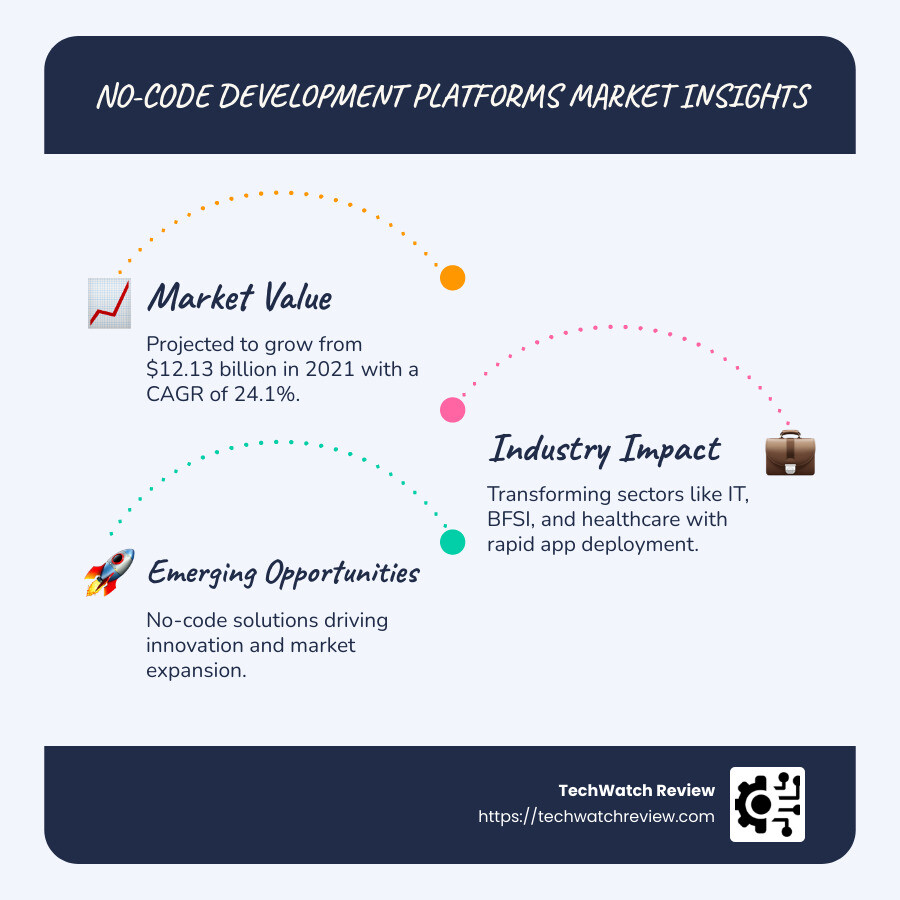
- Rapid Growth: The market was valued at USD 12.13 billion in 2021, with projections to expand at a robust CAGR of 24.1%, expected to reach considerable heights by 2030. For more details, check out this article on market growth.
- Diverse Applications: These platforms are impacting industries like IT & Telecom, BFSI, and healthcare by enabling rapid deployment of intuitive applications. Learn more about no-code applications in healthcare.
- Emerging Opportunities: As businesses strive for agility, the demand for no-code solutions opens vast opportunities for innovation and market expansion. Explore emerging opportunities in no-code.
The surge in no-code platforms is reshaping the tech industry, making it crucial for businesses to stay informed and leverage these tools for a competitive edge.

Similar topics to no code development platforms software market:
– best no code platforms
– no code ecommerce platform
– no code game development platforms
What are No-Code Development Platforms?
No-code development platforms are revolutionizing the way software is built by removing the need for traditional coding. These platforms use visual development tools and a drag-and-drop interface, making it possible for anyone—even those without technical skills—to create applications. This approach democratizes the software development process, allowing more people to bring their ideas to life.
Low-Code vs No-Code
While low-code and no-code are often mentioned together, they cater to slightly different needs. Low-code platforms require some coding knowledge, offering developers the flexibility to customize applications further. In contrast, no-code platforms eliminate coding altogether, allowing users to build software without any programming skills. For example, WordPress is a low-code tool that allows for customization through coding, whereas platforms like AppMySite provide a completely code-free environment.
Visual Development Tools
At the heart of no-code platforms are visual development tools. These tools use a graphical user interface (GUI) that allows users to design applications by arranging pre-built components. This method is not only user-friendly but also efficient, reducing development time by up to 75% as noted in recent studies. For more insights on how these tools are transforming the industry, you can explore TechWatch Review’s article on visual development.
Drag-and-Drop Interface
The drag-and-drop interface is a hallmark of no-code platforms. It lets users select, move, and configure elements on a digital canvas, much like building with digital LEGO bricks. This intuitive process eliminates the complexity of writing code, making it accessible to business users and entrepreneurs alike. For instance, platforms like Airtable and Bubble offer such interfaces, enabling users to quickly prototype and launch applications. For a deeper dive into how these interfaces work, check out TechWatch Review’s guide on drag-and-drop interfaces.
Market Overview of No-Code Development Platforms
The no-code development platforms software market is experiencing remarkable growth, driven by the need for rapid application deployment and reduced reliance on IT professionals. As of 2023, the market size was estimated at USD 3.83 billion and is projected to grow at a compound annual growth rate (CAGR) of 30.6%, reaching a staggering USD 187 billion by 2030. This explosive growth highlights the increasing demand for these platforms as businesses seek more efficient ways to develop applications.
Current Market Size and Growth Projections
The no-code development market is on a steep upward trajectory. With a market size of USD 3.83 billion in 2023, it is set to expand significantly over the next few years. By 2030, the market is expected to reach USD 187 billion, underscoring the widespread adoption and increasing reliance on no-code solutions. This growth is fueled by the platforms’ ability to streamline development processes and empower non-technical users to create robust applications.
Key Statistics and Facts
The rise of no-code platforms is reshaping the software development landscape. By 2024, it’s anticipated that 65% of app development will be powered by no-code or low-code technologies. This shift not only democratizes the development process but also leads to significant efficiency gains. For example, these platforms can reduce development time by up to 75%, allowing businesses to bring products to market faster and respond to changing demands swiftly.
Moreover, the cost benefits are substantial. No-code platforms can cut development costs by 65%, making them an attractive option for startups and small to medium enterprises (SMEs) looking to optimize budgets without compromising on functionality or innovation.
The adoption of no-code platforms is not just a trend but a strategic move for many businesses. As organizations continue to face IT resource constraints, these platforms offer a viable solution to bridge the gap, enabling faster deployment and fostering innovation across various sectors.
For more insights on how no-code platforms are transforming industries, check out our article on TechWatch Review.
Key Players in the No-Code Development Platforms Software Market
The no-code development platforms software market is busy with innovation, and several key players are leading the charge. These companies are at the forefront of changing how applications are built and deployed, making development accessible to a wider audience.
Leading Companies and Their Offerings
Appy Pie stands out with its user-friendly drag-and-drop interface, allowing users to create mobile apps without any coding knowledge. It’s particularly popular among small businesses and entrepreneurs for its affordability and ease of use.
Airtable combines the simplicity of a spreadsheet with the power of a database, offering a flexible platform for building collaborative apps. Its intuitive design makes it a favorite for project management and data organization.
Zoho provides a comprehensive suite of tools, including its no-code platform, Zoho Creator, which helps businesses automate workflows and build custom apps. Zoho’s integration capabilities and extensive feature set make it a strong contender in the market.
Salesforce has integrated no-code capabilities into its ecosystem, allowing businesses to build apps on its robust platform. With Salesforce Lightning, users can create sophisticated customer relationship management (CRM) apps without complex coding.
Microsoft offers Power Apps, a part of the Microsoft Power Platform, which enables users to build custom business applications. Its deep integration with other Microsoft products like Office 365 and Azure makes it a go-to choice for enterprises.
Emerging Players and Innovations
Bubble is gaining traction with its visual programming platform, which allows users to create web and mobile apps with complex logic and database interactions. Its community-driven approach and extensive resources support innovation and learning.
Creatio focuses on automating business processes and CRM. Its no-code platform is designed for rapid development and customization, catering to industries like finance and healthcare.
Mendix offers a robust platform for agile development, enabling teams to collaborate efficiently using its visual development tools. Its integration with cloud services like AWS and Microsoft Azure improves its versatility.
OutSystems provides a high-performance platform for developing enterprise-grade applications. Known for its scalability and security, OutSystems is ideal for businesses looking to modernize their IT infrastructure.
These companies, along with others like AppSheet, Quickbase, and Kintone, are continuously innovating, offering new features and capabilities that cater to the evolving needs of businesses across various industries. As the demand for no-code solutions grows, these players are well-positioned to lead the market and drive further adoption.
Industries Adopting No-Code Development Platforms
No-code development platforms are revolutionizing various industries by offering accessible, cost-effective, and efficient solutions for digital change. Let’s explore how different sectors are leveraging these platforms.
IT & Telecom
In the IT and Telecom sector, no-code platforms are streamlining automation and infrastructure monitoring. Companies are using these tools to automate repetitive tasks, thus freeing up valuable resources for more complex projects. For instance, log analysis can be automated to quickly identify and resolve issues, enhancing overall network reliability and performance. Learn more about automation in IT.
BFSI
The Banking, Financial Services, and Insurance (BFSI) industry is embracing no-code platforms to improve customer experience. By deploying chatbots and virtual assistants, financial institutions can offer personalized services and support 24/7. These tools are not only enhancing customer satisfaction but also reducing operational costs by automating routine inquiries and transactions. Explore how BFSI is transforming.
Healthcare
In the Healthcare industry, no-code platforms are changing patient care and operational processes. Healthcare providers are using these tools to develop AI applications for diagnostics and patient monitoring, enabling faster and more accurate medical decisions. By automating administrative tasks, healthcare facilities can focus more on patient outcomes and less on paperwork. Discover innovations in healthcare.
Education
Educational institutions are turning to no-code platforms to develop interactive learning tools and manage administrative tasks efficiently. These platforms enable educators to create custom applications for student engagement, course management, and performance tracking without needing technical expertise. Read about education technology.
Media & Entertainment
The Media & Entertainment industry is using no-code platforms to produce engaging digital content and manage complex workflows. These tools allow creators to develop custom applications for content distribution, audience interaction, and analytics, helping them stay ahead in a competitive market. See how media is evolving.
Retail
Retailers are leveraging no-code platforms to improve their e-commerce capabilities and streamline supply chain operations. By building custom apps for inventory management, customer loyalty programs, and personalized shopping experiences, retailers can improve efficiency and drive sales. Find out more about retail innovations.
Government
Government agencies are adopting no-code platforms to improve service delivery and citizen engagement. These platforms enable the rapid deployment of applications for public services, data management, and communication, making government processes more transparent and efficient. Learn about government tech.
Manufacturing
In the Manufacturing sector, no-code platforms are being used to optimize production processes and manage supply chains. By automating routine tasks and integrating IoT devices, manufacturers can improve operational efficiency and reduce costs. Explore manufacturing advancements.
As these industries continue to adopt no-code development platforms, they are opening up new opportunities for innovation and growth. The flexibility and ease of use offered by these platforms empower organizations to quickly adapt to changing market demands and technological advancements.
Regional Analysis of the No-Code Development Platforms Market
North America
North America is leading the no-code development platforms software market with significant market dominance. The region benefits from a strong presence of key players such as Microsoft, Google LLC, and Amazon.com Inc., who are continuously innovating and expanding their offerings. The demand for no-code solutions is driven by the need for rapid digital change and the adoption of new technologies. The region’s robust infrastructure and advanced technological capabilities support the seamless integration of no-code platforms across various industries.
Asia Pacific
Asia Pacific is experiencing the fastest growth in the no-code market, fueled by a thriving start-up ecosystem. Countries like China, India, Singapore, and South Korea are at the forefront of this growth, with numerous tech start-ups seeking accessible tools to develop AI applications. These start-ups are leveraging no-code platforms to overcome the lack of technical resources and expertise. Additionally, localized interfaces and industry-specific solutions are gaining traction in the region, catering to unique business needs and languages. Partnerships, such as the one between Tech Data Corp. and Simplifai.ai, highlight the strategic moves to improve AI solutions in the Asia Pacific market.
Europe
In Europe, the adoption of no-code platforms is driven by the increasing demand for AI applications and industry-specific solutions. The UK holds the largest share of the market, with a focus on advanced visual AI applications. Germany is also expected to see rapid growth due to its emphasis on technological innovation within the Industry 4.0 framework. No-code platforms in Europe are enabling businesses to quickly develop and deploy AI-driven solutions without extensive coding skills, thus promoting a culture of innovation. However, the regulatory environment in Europe requires companies to ensure compliance with data protection and privacy standards, which can influence the adoption and implementation of these platforms.
Latin America
Latin America is gradually embracing no-code development platforms as businesses seek to improve efficiency and reduce costs. The region’s growing digital economy and increasing internet penetration present opportunities for no-code platforms to expand their reach. Companies in sectors such as retail and government are beginning to adopt these platforms to improve service delivery and operational processes.
Middle East & Africa
In the Middle East & Africa, the adoption of no-code platforms is still in its early stages. However, there is potential for growth as more organizations recognize the benefits of these solutions in driving digital change. The region’s focus on smart city initiatives and digital government services presents opportunities for no-code platforms to contribute to infrastructure development and service optimization.
As the global demand for no-code development platforms continues to rise, each region presents unique opportunities and challenges. Businesses across the world are leveraging these platforms to drive innovation and stay competitive in a rapidly evolving digital landscape.
Benefits of No-Code Development Platforms
Accessibility and Ease of Use
No-code development platforms are revolutionizing how businesses approach software creation. They offer drag-and-drop and visual interfaces, making it easy for non-technical users to build applications. This accessibility is a game-changer, allowing individuals without coding skills to participate in software development. According to Gartner, 82% of firms find custom app development outside of IT important, highlighting the need for accessible tools. For more insights on how no-code platforms are transforming industries, check out TechWatch Review’s article on digital transformation.
Cost-Effectiveness
Building software traditionally requires hiring specialized talent, which can be costly. However, no-code platforms significantly lower development costs. These platforms reduce the need for specialized developers, as highlighted in a Forrester study, which found that companies avoided hiring two IT developers, resulting in a $4.4 million increase in business value over three years. Moreover, developing applications with no-code tools can cut costs by 65%, making them a financially attractive option. Explore more about cost-saving strategies in TechWatch Review’s cost management guide.
Speed and Efficiency
The speed at which applications can be developed using no-code platforms is another major benefit. These platforms enable rapid application deployment, reducing development time by up to 90%. This is crucial for businesses aiming to get their products to market quickly and efficiently. A report by TechRadar notes that no-code solutions can lead to a 75% reduction in development time, allowing companies to respond swiftly to market demands. For a deeper dive into improving development efficiency, visit TechWatch Review’s efficiency improvement tips.
In summary, no-code development platforms provide businesses with tools that are accessible, cost-effective, and efficient. By reducing dependency on IT professionals and enabling faster deployment, these platforms empower organizations to innovate and adapt quickly in a competitive market.
Challenges and Considerations
Security and Scalability
When it comes to no-code development platforms, security remains a top concern. These platforms often store data in the cloud, which can pose risks if not managed properly. Ensuring data safety is paramount, especially when handling sensitive information. It’s essential for businesses to evaluate whether a cloud-based or on-premises solution is more secure for their specific needs. According to a Gartner report, many organizations are opting for hybrid models to balance flexibility and security.
Scalability is another critical consideration. As businesses grow, their software needs to scale accordingly. While no-code platforms offer quick deployment, they may struggle with scalability. It’s important to choose platforms that can handle increased demand without compromising performance. This requires a careful assessment of the platform’s capabilities and limitations. For more insights on scalability, you can refer to TechWatch Review’s article on scalability challenges.
Customization Limitations
While no-code platforms provide ease of use with pre-built templates, they often come with customization limitations. These platforms are designed to cater to common use cases, which might not fit every business’s unique needs. The limited flexibility can hinder organizations that require highly customized solutions. For instance, while a TechCrunch article highlights the rapid deployment of applications using no-code tools, it also notes that some businesses may need to invest in additional development to achieve the desired functionality. For more on customization, see TechWatch Review’s insights on customization in no-code platforms.
Ethical Considerations
Ethical considerations are becoming increasingly important in the development of digital applications. No-code platforms must prioritize fairness, transparency, and accountability. As more non-technical users engage in software development, there is a risk of inadvertently creating biased algorithms or applications that lack transparency. Ensuring that no-code solutions adhere to ethical standards is crucial for maintaining trust and integrity in digital products. This includes implementing mechanisms for accountability and ensuring transparency in how applications function and handle data. For further reading on ethical considerations, visit TechWatch Review’s article on ethics in no-code development.
Future Trends in No-Code Development Platforms
AI Integration
The integration of artificial intelligence (AI) into no-code platforms is revolutionizing application development and deployment. With tools like automated machine learning and natural language processing, these platforms are becoming increasingly intelligent and efficient. For instance, platforms like Notion Data Service utilize AI to provide data-driven insights and recommendations, simplifying complex tasks for users. This integration enables even non-technical users to harness machine learning capabilities, facilitating the creation of sophisticated applications without requiring deep technical expertise. For more insights on AI integration, you can explore TechWatch Review’s article on AI in no-code platforms.
Web3 Development
Web3 signifies the next phase of the internet, emphasizing decentralization and blockchain technology. No-code platforms are pivotal in making Web3 accessible to a broader audience. Through visual development tools, users can create smart contracts and digital currencies without needing to comprehend the underlying blockchain code. An example is the decentralized finance platform Cryptfunder, which employs no-code tools to facilitate digital asset lending. This democratization of technology is essential for the widespread adoption of Web3, as it reduces the barriers to entry for individuals and businesses. Learn more about Web3 development in TechWatch Review’s Web3 overview.
Cloud Technologies
The emergence of cloud technologies is another trend influencing the no-code development landscape. Platforms like AWS offer robust infrastructure for data processing and remote access, enabling users to build and deploy applications from anywhere. Cloud-based no-code platforms provide scalability and flexibility, allowing businesses to swiftly adapt to changing demands. This is particularly advantageous for small and medium enterprises that need to scale their operations without significant investment in IT infrastructure. For further reading on cloud technologies, visit TechWatch Review’s cloud technology insights.
IoT Applications
The Internet of Things (IoT) is expanding the capabilities of no-code platforms, enabling users to create applications that interact with connected devices. By integrating IoT with no-code development, users can automate processes and gather real-time data from various sources. This opens up new possibilities for industries like healthcare, manufacturing, and retail, where IoT applications can enhance operational efficiency and improve customer experiences. Discover more about IoT applications in TechWatch Review’s IoT exploration.
The future of no-code development platforms is promising, with AI, Web3, cloud technologies, and IoT driving innovation and growth. As these platforms continue to evolve, they will further democratize technology, making it accessible to a broader audience and fostering creativity and innovation across industries.
Frequently Asked Questions about No-Code Development Platforms
What is the difference between low-code and no-code development?
Low-code and no-code development platforms are both designed to simplify the software development process, but they cater to different user needs.
-
Low-code platforms require some coding knowledge. They offer a visual development environment with drag-and-drop components, but users can also write custom code to add specific functionalities. This makes low-code platforms ideal for developers who need to rapidly build applications while retaining the ability to customize.
-
No-code platforms, on the other hand, are designed for users with no coding experience. They provide a fully visual interface where users can build applications by simply dragging and dropping elements. This approach is perfect for business users and non-developers who want to create applications quickly without writing any code.
For more detailed insights, you can explore this Gartner report.
How big is the no-code platform market?
The no-code platform market is experiencing rapid growth. As of 2021, the market was valued at approximately USD 12.13 billion and is projected to grow at a compound annual growth rate (CAGR) of 24.1% by 2030. By 2024, the market size is expected to reach USD 12.3 billion, driven by the increasing demand for rapid application development and automation of business processes.
This growth is further supported by the fact that by 2025, 70% of new applications developed by enterprises will use low-code or no-code technologies, according to Forrester.
Are no-code developers in demand?
Yes, no-code developers are increasingly in demand. As businesses strive to digitize quickly and efficiently, the need for professionals who can leverage no-code platforms to build applications is rising. This demand is fueled by the shortage of traditional software developers and the need for rapid development cycles.
In fact, 82% of firms have acknowledged the importance of custom app development outside of traditional IT departments, according to a recent survey by Forrester. This trend highlights the growing role of no-code developers in bridging the gap between business needs and technical execution.
As the no-code movement continues to gain traction, it opens up new career opportunities for individuals with a strong understanding of business processes and a knack for using no-code tools to create innovative solutions.
The no-code development platforms software market is poised for significant growth, with projections indicating a rise from USD 12.13 billion in 2021 to USD 187 billion by 2030. This expansion is fueled by the increasing demand for rapid application development and business process automation across various industries.
Growth Opportunities: The need for no-code solutions is rising in sectors such as IT & Telecom, BFSI, and Healthcare. These platforms enable non-developers to create complex applications, reducing reliance on IT professionals and significantly cutting costs. By 2025, it’s anticipated that 70% of new applications will be developed using low-code or no-code platforms, highlighting their growing importance.
At TechWatch Review, we are dedicated to providing you with the latest insights and opportunities in the no-code market. Our expert analyses and detailed guides are crafted to help you navigate this evolving landscape. Explore more about no-code platforms on our website to stay ahead in the digital transformation journey. Additionally, check out our in-depth article on the impact of no-code platforms in the healthcare sector.
The no-code revolution is not just about simplifying the development process; it’s about democratizing technology and fostering innovation at every level. As these platforms continue to advance, they offer exciting prospects for businesses and individuals to leverage technology without extensive coding skills.